Create and maintain a codebook
A codebook defines the topics, needs, or patterns you look for. It belongs to a project and applies to every session in that project. Clear definitions help different coders classify the same statement consistently.
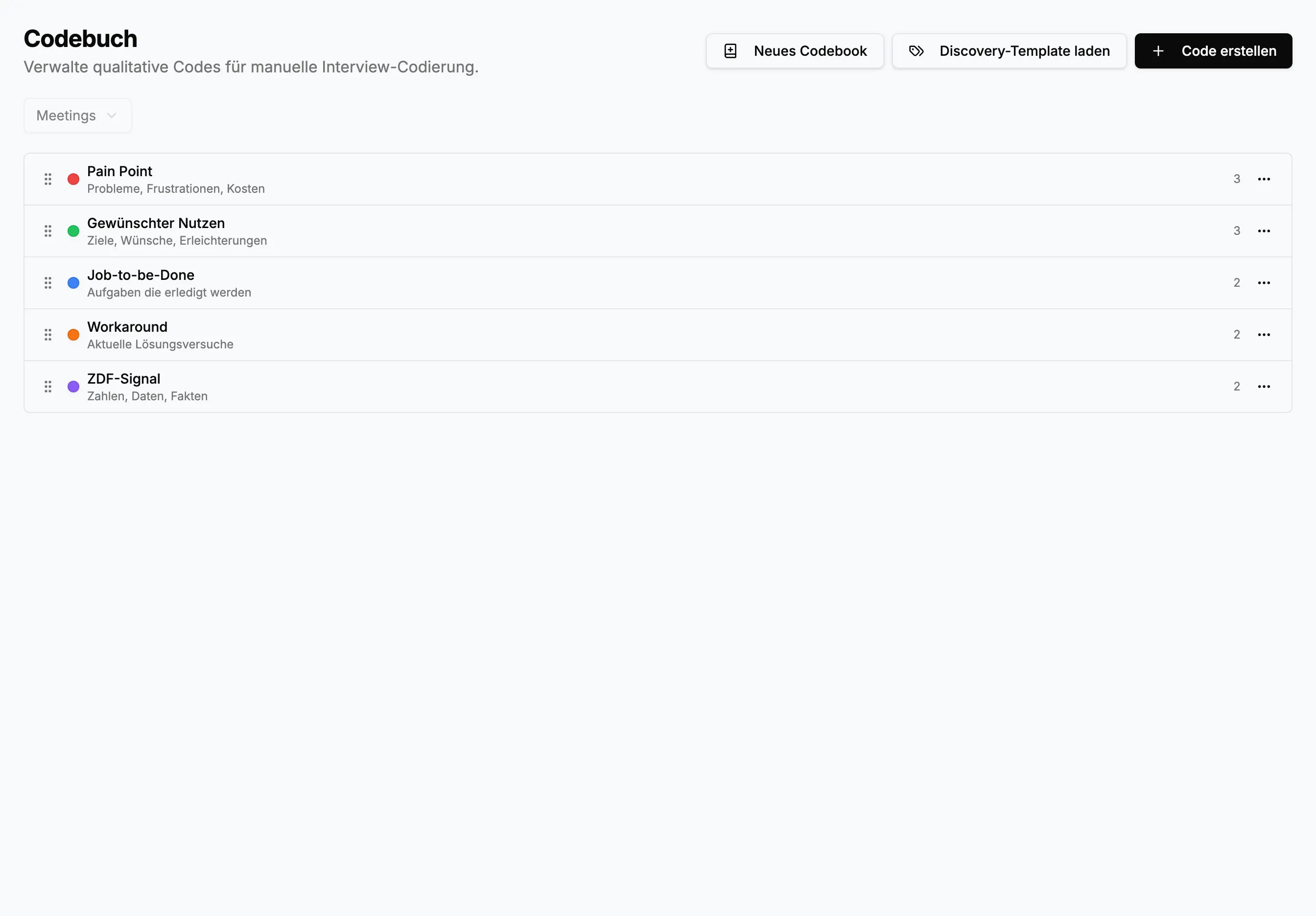
Create the codebook
Section titled “Create the codebook”- Open Codebook and select the project.
- Choose New codebook if the project has none.
- Start empty or load the Discovery template.
- Create the first code with a name, description, and color.
- Add other codes and arrange subcodes where necessary.
| Discovery code | Guiding question |
|---|---|
| Pain Point | What problem, frustration, cost, or effort is described? |
| Desired Benefit | What improvement or effect is expected? |
| Job-to-be-Done | What task does the person actually need to complete? |
| Workaround | How is the problem handled today? |
| ZDF Signal | Which number, date, or verifiable fact is mentioned? |
Define robust codes
Section titled “Define robust codes”For every code, state its meaning, inclusion criteria, exclusion criteria, and at least one example. For example:
Access barrier – Organizational, physical, language, or digital obstacles that make participation harder. Exclude general dissatisfaction without a concrete obstacle.
Use subcodes for meaningful variants such as Access barrier > digital and
Access barrier > physical. Deep trees are difficult to apply consistently;
two levels are enough for many projects. Colors aid orientation but should
remain distinguishable. Drag codes to reorder or nest them.
Change and govern the structure
Section titled “Change and govern the structure”Refine definitions when boundaries fail in real material and document material method changes in a memo. Before a major restructure, create a report snapshot that records the selected corpus and codebook state.
Deleted codes move to trash first and can be restored. Before permanent removal, check which segments use the code. Treat code merges as methodological changes and review the affected quotes.
For team projects, appoint an owner for structural changes, code the same sample independently, compare differences, and refine definitions using real borderline cases. Then continue with Coding transcripts.